After upgrading to my extra ham radio license, I picked up a Yaesu FT-710 and started building an HF station at home. Although my QTH has plusses like easy access to a high roof that has help a lot with antenna performance on transmit, ultimately I live in an urban area in Seattle with a lot of QRM. There’s both a constant level of static that varies from S5 to S9 depending on band and time of day, but also some very strong focused noise on frequencies like 14.250MHz that probably comes from LED lights or other devices in my neighborhood. I’m able to hunt very strong POTA signals or “booming” stations with directional antennas, but it’s a lot of work. Moreover, I still haven’t found a great way to put up a permanent antenna at home. I set up and take down a dipole whenever I want to play radio.
This has lead me toward portable operation over time. Although I’m writing this in November of 2025, the post is going to cover portable operations I did in July and August of this year.
Island Center Forest
When I first started investigating portable operation, I wanted to go to a place with a low noise floor where there wouldn’t be a lot of people. I was still fairly anxious about people asking me questions about what I was doing. I wanted to know how much better radio reception could be in a rural area. Also, I really had no idea what I was doing.
For whatever reason, I ended up picking the Island Center Forest on Vashon Island as a place to go on a nice summer day. This public land is managed by King County. The southern side of forest near the Cemetary Trailhead is just walking trails. There are no facilities there like a playground or picnic shelter that were going to attract crowds. Getting to Vashon requires taking a ferry which is also an impediment to most casual hikers or walkers.
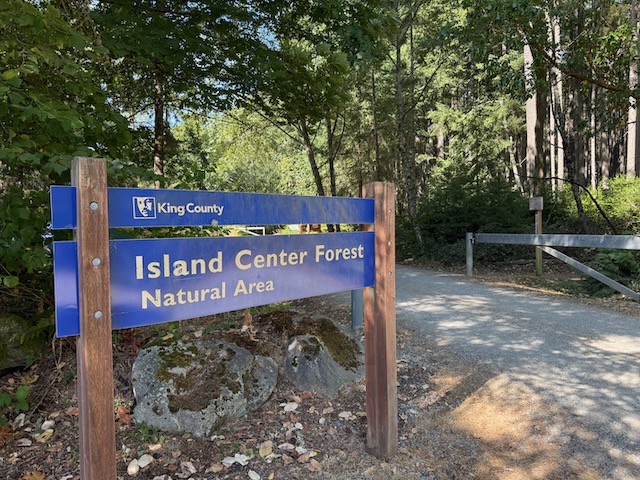
When I got to the trailhead, there was a small gravel parking lot with only a portable toilet and garbage can. This seemed perfect. I walked around the trails a bit, trying to find a good place to set up a dipole. At the time, I only had a 13ft fiberglass fishing pole I had bought at Walmart, which meant I needed to find two trees the rigt distance apart and some means of supporting the fishing pole mast.
Fortunately, I found an uncovered picnic table in an area with a few well space trees next to a clearing. I’d brought my x-table portable worktable to support the fishing pole mast.
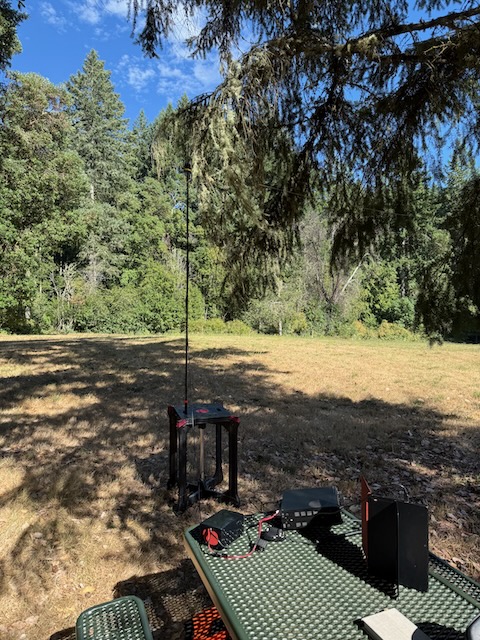
Even though the antenna was very low to the ground, I got my 15m dipole set up. I was shocked how quiet the noise floor was! I could hear so many different conversations now matter where I spun the dial. I felt like my home QTH was ruined from that point on. But seriously, I do still operate at home sometimes by working through the noise when conditions are good, and by using digital modes.
I only made 3 contacts on 15m on FT8. Not very productive, but I learned a few things beyond the luxury of a low noise floor:
- Finding the right spacing for trees for a dipole was going to be a pain.
- An antenna low to the ground wasn’t going to work as well as at home where I can place a dipole 40ft above ground easily.
- Hunting stations was easier because I could receive more of them, but making SSB contacts was still challenging.
- Hauling around a lot of heavy radio equipment is a hassle. Eventually, I wanted to get everything small enough to carry in a single backpack or possibly even on my bicycle. The FT-710 is still a compact base station more than a field radio, despite the branding. More about that in future posts.
- Operating outside on a picnic table in the shade in the PNW summer was really great.
- Don’t forget your regular glasses. I was wearing my prescription sunglasses which are polarized. That made it difficult to read the screen on my radio and impossible to read my computer screen. Fortunately, I was able to turn the Microsft Surface into portrait mode.
Beaver Lake Park
For my next attempt, I went east to the Sammamish plateau. I explored quite a few parks in the area, still feeling too inexperienced to activate a park for POTA. I ended up finding a quiet forested corner of this park to set up portable using the trees and my x-table again.
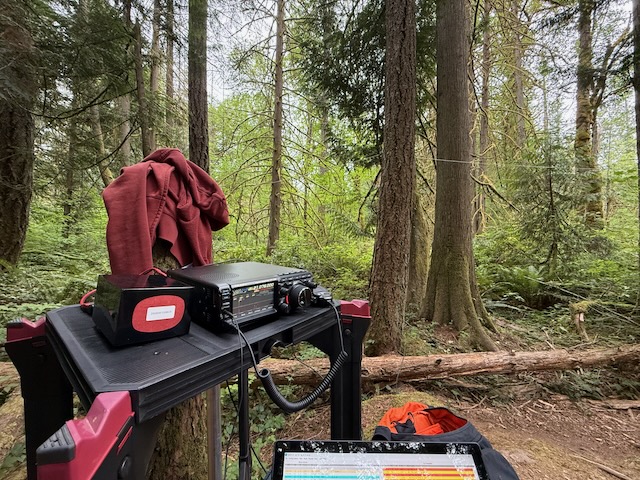
This time, I ended up making 6 FT8 contacts, also on 15m. In practical terms, the antenna was even lower to the ground than it had been at the last park. By this point, I was more convinced that I needed a different antenna set up. Also, mosquitos can be a thing in the PNW in summer in dense wooded areas like this.
Genesee Park
In the interim I had bought a commercial 10-40m end fed half wave antenna. I had tried it out at home unfurled on my roof, not even up in the air because I don’t have the space. I made one extremely noisy FT8 contact on 15m, which proved it was generally working. This was right before I stayed at an Airbnb in the mountains with some friends. There I’d made a few more 20m FT8 contacts. I was able to get the antenna up a bit higher because of how the space was arranged, but it was still low and the QTH was in a valley.
The biggest evolution in these early portable experiments came when I set up the EFHW on a nice summer day in Genesee Park in Seattle along Lake Washington.
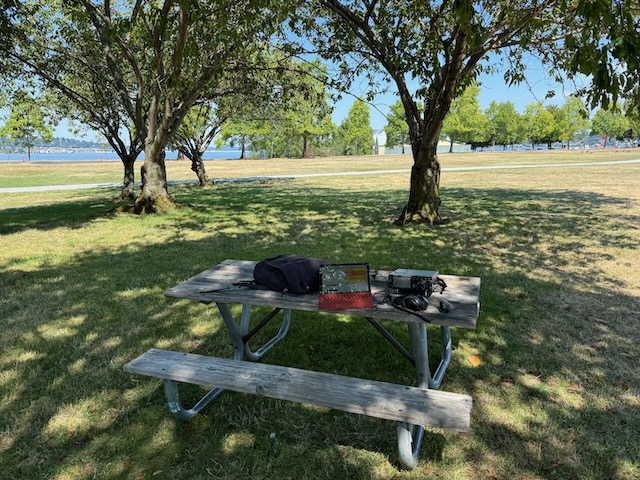
I used a throw bag and line to get the antenna up quite a bit higher in a tree than I’d been able to get with my makeshift fishing pole mast. It was oly 20 to 25ft up at the pinnacle in an inverted V configuration. Still, I made 7 FT8 contacts and 6 SSB POTA hunting contacts on 10m, 15m, and 20m!
By this point, I was starting to feel more confident about activating a park for POTA. I was enjoying operating outdoors with some good PNW summer weather. However, finding a site and getting everything set up was still somewhat of an ordeal.